

Who Am I Now? Rebuilding Your Identity After Infertility
Who am I now?
For many people navigating infertility, this question becomes one of the most difficult and unexpected parts of the journey. Infertility is often talked about in terms of medical treatments, appointments, procedures, and decisions, but the emotional impact can reach far beyond the physical experience of trying to conceive. It can affect how you see yourself, how you imagine your future, and how you understand your place in the world.
This is a question I know personally. After walking my own path through infertility and experiencing the grief of a future that looked different than I had imagined, I understand how deeply this journey can impact our sense of identity, purpose, and hope. It was through navigating this loss that I came to understand that infertility grief is not only about what we hoped to gain, it is also about learning how to reconnect with ourselves when life does not unfold the way we expected.
For years, your life may have been shaped around the hope of becoming a parent. There may have been appointments, treatments, waiting periods, and countless moments of uncertainty woven into your everyday life. You may have imagined what your family would look like, what kind of parent you would be, and the experiences you hoped you would share.
When that future begins to change, whether through unexpected childlessness, the decision to stop pursuing fertility treatments, or realizing that the path forward looks different than you imagined, the grief can feel much deeper than the loss of a dream. It can feel like the loss of an identity.
You may find yourself wondering:If I am not becoming the person I thought I would be, then who am I now?
This question can feel painful and overwhelming. However, it can also become an opportunity to reconnect with yourself, rediscover what matters to you, and begin creating a meaningful life that honours both what you have lost and who you are becoming.
When Infertility Becomes Part of Your Identity
Infertility is not just a medical experience. It is an emotional journey that can impact nearly every area of your life.
For many people, the process of trying to conceive gradually becomes a significant part of their identity. Your thoughts may become focused on appointments, timelines, treatment options, and decisions. Your emotions may become connected to pregnancy announcements, test results, and moments of hope or disappointment. Your future may feel as though it is waiting for one important piece of your life to fall into place.
Over time, it can begin to feel as though infertility is not just something you are experiencing, it becomes something that defines your experience of yourself.
This is understandable. When something requires so much emotional energy, time, and attention, it naturally becomes woven into your daily life. The hopes you carried, the decisions you made, and the challenges you endured all become part of your story.
For many people, becoming a parent was not simply a goal. It was part of how they imagined themselves in the future. It represented family, connection, purpose, and belonging.
So when that future becomes uncertain or changes completely, it makes sense that you may feel lost. You are not only grieving what happened; you are also grieving the person you thought you would become.
Grieving the Life You Imagined
When we think about infertility grief, we often focus on the loss of a pregnancy or the inability to conceive. These experiences can carry profound grief, but infertility grief can also involve mourning the future you had envisioned.
You may be grieving the family you imagined creating, the traditions you hoped to establish, the relationship you pictured having with your child, or the milestones you expected to experience.
You may also be grieving a version of yourself.
Perhaps you imagined yourself becoming a mother or father. Perhaps you pictured how this role would shape your relationships, your priorities, and your sense of purpose. When that future changes, it can leave you questioning where you fit and what comes next.
This type of grief can be especially difficult because it is often invisible to others. There may not be a clear moment when your loss is recognized or acknowledged. Instead, grief can show up unexpectedly, for example, during a baby announcement, a family gathering, a holiday, or a quiet moment when you realize your life looks different than you once imagined.
These moments can be painful reminders that grief is not only about what happened. It is also about what you hoped would happen.
The dreams you carried mattered. The future you imagined mattered. And it is natural to need time and space to process what it means when those dreams change.
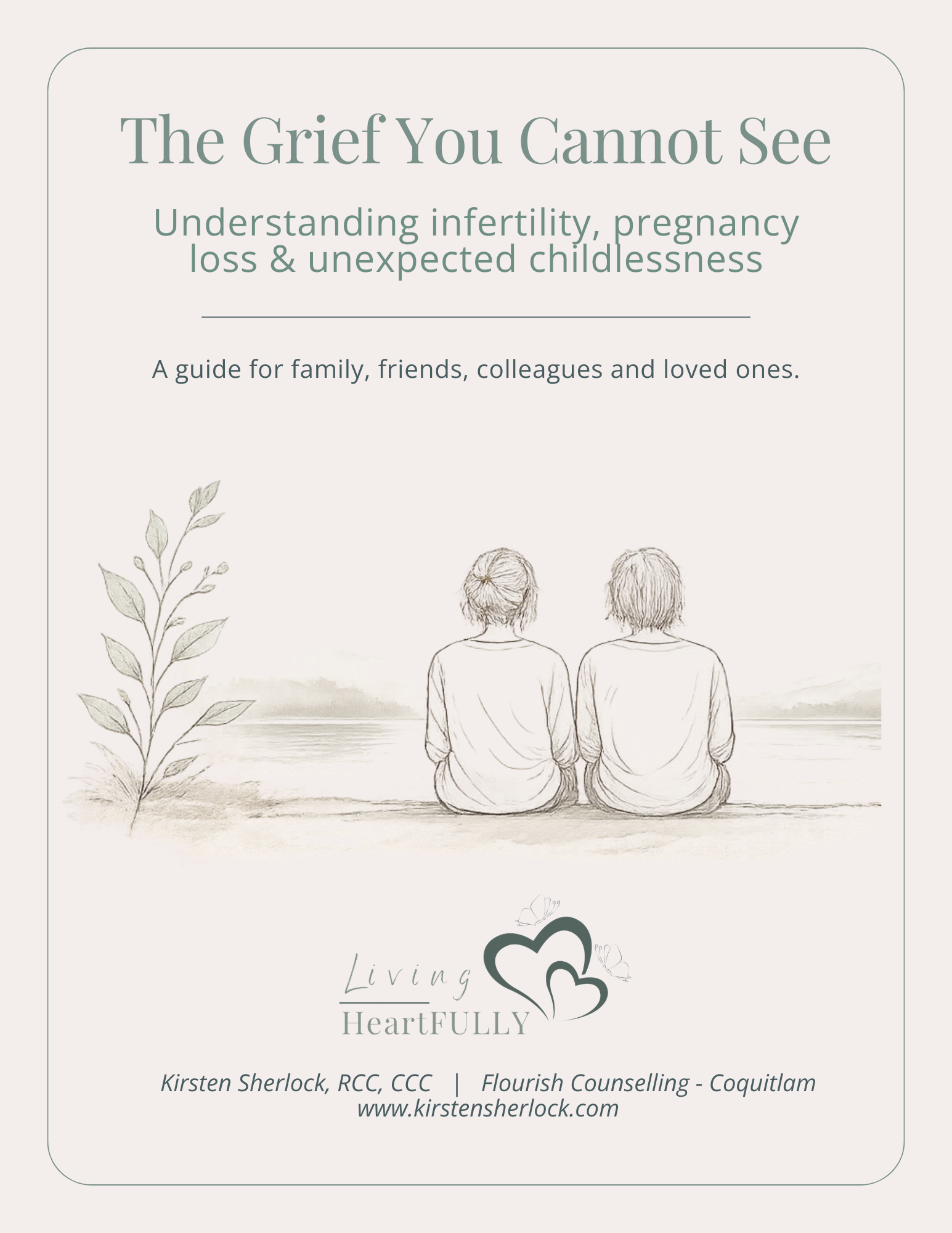
Looking for a way to help others understand infertility grief? 🌿
Infertility grief can be difficult to explain to the people around you, particularly when the losses you are grieving are not always visible or easily understood. I created a free resource, The Grief You Cannot See: Understanding infertility, pregnancy loss & unexpected childlessness, to help partners, family members, friends, and other loved ones better understand the emotional complexity of infertility and unexpected childlessness.
The Challenge of Moving Forward Without Moving On
One of the hardest parts of infertility grief can be feeling pressure to “move on.”
Sometimes this pressure comes from others who want to help but do not fully understand the depth of the experience. Comments such as “everything happens for a reason,” “at least you know you tried,” or “you can always focus on other things” are often offered with good intentions, but they may unintentionally minimize the complexity of what you are carrying.
The reality is that moving forward is not the same as moving on.
Moving forward does not mean forgetting what you hoped for. It does not mean that the dream of becoming a parent no longer mattered. It does not mean you need to find a positive lesson in your experience before you are ready.
Healing does not require you to erase your grief.
Instead, healing often involves learning how to carry your grief differently. It means allowing space for the sadness, love, longing, and uncertainty while also beginning to make room for the parts of life that are still available to you.
You can honour what was lost while still exploring what comes next.
Rediscovering Yourself Beyond Infertility
When so much of your life has been focused on trying to conceive, it can feel unfamiliar to begin asking questions about yourself beyond infertility. For years, your attention may have been directed toward a very specific hope and future. Your decisions, plans, and emotional energy may have been shaped around becoming a parent.
When that path changes, it can leave you wondering where to place all of that energy now.
You may find yourself asking:
What brings me joy now?
What matters to me outside of becoming a parent?
Who am I when I am not waiting for the next appointment, decision, or outcome?
What parts of myself have I lost touch with along the way?
These questions can feel uncomfortable at first. They may bring up sadness, uncertainty, or even guilt. Some people worry that exploring new interests, experiencing moments of happiness, or imagining a different future means they are letting go of what they hoped for.
But rebuilding your identity does not mean abandoning your dreams or pretending the journey did not matter. It does not mean infertility becomes “a lesson” you needed to learn or that you need to quickly find a new purpose to replace the one you lost.
Sometimes, the first step is not finding a new purpose.
Sometimes, the first step is simply finding your way back to yourself.
Reconnecting with yourself can begin with curiosity rather than pressure. Instead of asking, “What is my new purpose?”, a question that can feel overwhelming, you might begin with gentler questions:
What brings me moments of peace?
What makes me feel most like myself?
What have I always enjoyed but may have set aside during my fertility journey?
What values do I want to guide this next chapter of my life?
Exploring your values can be a meaningful place to begin. Values are not goals that you achieve or check off a list. They are the qualities and experiences that matter most to you and help guide how you want to show up in the world.
For example, perhaps you value connection, creativity, compassion, adventure, learning, helping others, or personal growth. These values existed before infertility, and they continue to exist regardless of how your path unfolds.
You are not only your fertility journey.
You are also your relationships, your strengths, your creativity, your compassion, your experiences, your values, and the ways you contribute to the world around you.
Infertility may be an important part of your story, but it does not have to become the only part of your story.
Rediscovering yourself is often a gradual process. It may begin with small moments of noticing: an activity that brings you joy, a conversation where you feel truly seen, time spent in nature, reconnecting with your body, creating something, learning something new, or spending time with people who remind you of who you are beyond infertility.
You do not have to rush into creating a completely new version of yourself.
The goal is not to become someone different.
It is to reconnect with the parts of yourself that have always been there and make space for the parts of yourself that have grown through everything you have experienced.
Creating a Meaningful Life After an Unexpected Change
One of the most challenging aspects of unexpected childlessness is that there is often no clear roadmap for what comes next. When we move through many other major life transitions, there are often recognizable milestones, rituals, and forms of support that help us understand where we are in the process. There may be celebrations when we get married, have a baby, graduate, or begin a new chapter. Even when those transitions are difficult, there is often a shared understanding of what has happened and what comes next.
When your path to parenthood changes, the transition can feel much quieter. There may be no clear moment when others recognize that something significant has changed in your life. You may still look the same on the outside, continue going to work, maintain your relationships, and participate in everyday life while internally trying to make sense of a future that no longer looks the way you expected. This can make unexpected childlessness feel particularly isolating. You are navigating a significant life transition, but there may be few markers to help you understand where you are or how you are supposed to move forward.
Part of healing may involve creating your own ways of acknowledging what you have experienced and what you are moving toward. This might mean giving yourself permission to recognize that something has changed, even if other people do not fully understand it. It might involve creating new traditions, marking the end of a particular chapter, finding supportive community, or simply allowing yourself time to consider what you want this next season of life to hold.
A meaningful life after infertility does not have to look like the life you originally imagined. This can be a difficult truth to hold, particularly when you spent years hoping, planning, and working toward a very specific future. Accepting that your life may look different does not mean that the original dream was not valuable or that you have stopped caring about what you lost. It simply means that your capacity for love, connection, purpose, and fulfillment is not limited to one particular path.
It can also be helpful to take the pressure off the idea that you need to immediately discover a new purpose. When a significant life dream changes, there can be an expectation to figure out what you are “meant” to do next or to find something that makes the loss feel worthwhile. But you do not have to turn your grief into a purpose or find a silver lining in your experience. Sometimes the next step is much simpler: noticing what feels meaningful, what feels nourishing, and what helps you feel connected to yourself and to others.
For some people, rebuilding their sense of identity may involve deepening relationships with the people who matter to them, exploring interests or passions that were put aside during the fertility journey, investing more time in creativity, spending time in nature, learning something new, travelling, or finding meaningful ways to contribute to their community. For others, it may involve creating new traditions, redefining what family means to them, strengthening their connection with their partner or friends, or simply making more room for experiences that bring a sense of presence and enjoyment.
There may also be value in starting very small. Rather than trying to envision your entire future, you might ask yourself what you would like more of in your life right now. Perhaps it is more connection, rest, creativity, adventure, laughter, learning, or time outdoors. These small choices can begin to reconnect you with your values and with the parts of yourself that may have become quieter while infertility occupied so much of your emotional and mental space.
There is no single definition of what a meaningful life should look like, and you do not have to create a life that makes sense to everyone else. Your path may look different from what you expected, and it may take time to discover what feels right for you. A life can hold grief and still contain beauty. It can look different from the one you imagined and still be deeply meaningful.
You are allowed to build a life that honours what you have lost while also making space for what is still possible. You do not have to choose between remembering the life you hoped for and participating fully in the life you have now. Over time, meaning can be found not in replacing the dream you lost, but in discovering what matters to you and allowing those values to guide the life you continue to create.
You Don't Have to Navigate This Alone 🌿
Rebuilding your identity after infertility can feel like a very personal journey, but you do not have to move through it entirely on your own. Sometimes being with others who understand the complexity of infertility, grief, and unexpected childlessness can provide a sense of connection and belonging that is difficult to find elsewhere.
Through Living HeartFULLY, I offer supportive group healing spaces for people navigating infertility and unexpected childlessness. These groups provide an opportunity to connect with others who understand, gently explore the changes you are experiencing, and make space for both grief and what may be possible in the future.
Explore upcoming groups → Living HeartFULLY
Allowing Grief and Hope to Exist Together
Many people feel as though they have to choose between honouring their grief and embracing the future. It can sometimes feel as though moving forward means they are leaving something behind, or that experiencing moments of happiness means they are no longer acknowledging how much this journey mattered.
But healing does not require choosing one over the other.
You can grieve the future you imagined and still create a future that matters. You can acknowledge the pain of infertility while also discovering new parts of yourself. You can carry sadness while also experiencing moments of connection, peace, and joy.
Grief and hope are not opposites. They can exist together.
In fact, healing often involves learning how to hold both. There may be days when grief feels heavier and days when you feel glimpses of excitement about what is ahead. There may be moments when you feel deeply connected to the life you are creating and moments when you still long for the life you thought you would have.
Both experiences are valid.
There is no need to measure your healing by how little you miss what you hoped for. Missing the dream of becoming a parent does not mean you are unable to appreciate your life as it is now. Feeling joy does not mean you are forgetting your loss.
Love and grief often exist together because grief is, in many ways, a reflection of how deeply something mattered.
The goal is not to become the person you were before infertility. Experiences that profoundly affect us often change us. The goal is not to erase what happened or force yourself to “move on” from a chapter that shaped you. Instead, healing often involves integrating this experience into your story in a way that honours what you have been through while allowing space for who you are becoming.
You may carry the wisdom, compassion, strength, and resilience that developed through your journey while also allowing yourself to explore new hopes, dreams, and possibilities.
Rebuilding your identity is not about replacing who you were. It is not about finding a new version of yourself that makes the loss feel acceptable. It is about recognizing that you are still whole, even after disappointment, uncertainty, and grief.
It is about discovering who you are now.
The person who has been shaped by your experiences, but not defined by them.
The person who can honour what was lost while continuing to build a life filled with meaning, connection, and moments of joy.
You Are More Than Your Infertility Journey
If you find yourself asking, “Who am I now?” after infertility, it may be because something deeply meaningful has changed.
You may be standing in the space between the future you imagined and the future you are beginning to create. That space can feel uncertain, painful, and lonely.
But it is also a place where new understanding, self-compassion, and growth can begin.
There is no timeline for rediscovering yourself. There is no right way to move through this transition. Your grief deserves compassion, and so does the person you are becoming.
You are more than what happened to you.
You are someone who has hoped deeply, loved deeply, and carried more than many people realize.
And even in the midst of grief, there is still the possibility of creating a life that feels meaningful, connected, and authentically yours.
FAQs
Q1: How does infertility affect your identity?
Infertility can affect much more than your plans for becoming a parent. When so much of your time, energy, and hope has been focused on building a family, it can become closely connected to how you see yourself and your future. When that path changes, it is natural to question who you are, what your life will look like, and where you find meaning and belonging now.
Q2: Why do I feel lost after infertility?
Feeling lost after infertility can be part of grieving a future that you had spent years imagining. When appointments, treatments, decisions, and trying to conceive have been such a significant part of your life, it can feel unfamiliar when there is no longer a clear next step. You may need time to reconnect with yourself and discover what matters to you outside of your fertility journey.
Q3: Is it normal to grieve infertility even if I never became pregnant?
Yes. Infertility grief is not limited to the loss of a pregnancy. You may also be grieving the child, family, experiences, and future you had hoped to have. This type of grief can be difficult to explain because the losses may not be visible to others, but they can still have a profound emotional impact.
Q4: How do I find myself again after infertility?
Finding yourself again after infertility is usually a gradual process rather than something that happens all at once. You might begin by reconnecting with activities you once enjoyed, spending time with people who make you feel like yourself, exploring your values, or noticing what brings you moments of peace, connection, or curiosity. You do not need to become a completely different person; you are learning to reconnect with the parts of yourself that may have been overshadowed by your fertility journey.
Q5: How do I rebuild my identity after infertility?
Rebuilding your identity can begin by exploring who you are beyond becoming a parent. Consider the values, relationships, interests, strengths, and experiences that are important to you. Rather than trying to replace the identity or future you had imagined, it can be more helpful to gradually discover what you want to carry forward and what you want to make room for in this next chapter.
Q6: Do I need to find a new purpose after infertility?
No. There is often pressure to find a new purpose after a significant loss, but you do not need to turn your infertility experience into a lesson or discover a new calling to make your life meaningful. Sometimes healing begins with much smaller questions, such as what brings you connection, peace, curiosity, or enjoyment. Meaning can develop gradually as you reconnect with your values and what matters to you.
Q7: Can I feel happy and still grieve infertility?
Absolutely. Grief and happiness can exist at the same time. Experiencing joy, connection, or excitement about your life does not mean that your infertility journey no longer matters or that you have forgotten what you lost. Similarly, having difficult days does not mean you are moving backward. Healing often involves making room for many different emotions rather than expecting grief to disappear completely.
Q8: How can I create a meaningful life after unexpected childlessness?
Creating a meaningful life after unexpected childlessness does not mean finding a replacement for the family or future you had imagined. It may involve exploring your values, deepening relationships, reconnecting with interests, creating new traditions, spending time on things that bring you joy, or finding meaningful ways to contribute to your community. There is no single definition of what a meaningful life should look like.
Q9: Why is unexpected childlessness so difficult to navigate?
Unexpected childlessness can be particularly difficult because there is often no clear roadmap for moving through it. Unlike many other major life transitions, there may be few rituals, milestones, or forms of recognition for the loss of an expected future. You may be trying to process a profound change internally while continuing to participate in everyday life, which can make the experience feel lonely or difficult for others to understand.
Q10: Can counselling help after infertility or unexpected childlessness?
Counselling can provide a supportive space to process grief, explore changes in identity, work through difficult emotions, and begin imagining what you want your life to look like moving forward. You do not have to be “ready to move on” before seeking support. Counselling can also provide space to honour what has been lost while gradually reconnecting with yourself and the parts of life that still feel meaningful.
If you are struggling with the emotional impact of infertility, unexpected childlessness, or a future that looks different than you imagined, counselling can provide a space to process your grief, reconnect with yourself, and explore what comes next.
I offer individual counselling for infertility and unexpected childlessness, both online and in person in Coquitlam, BC.
About Kirsten
Kirsten Sherlock, RCC, CCC is a Registered Clinical Counsellor and founder of Flourish Counselling in Coquitlam, BC. She specializes in supporting adults navigating infertility, unexpected childlessness, trauma, grief, anxiety, stress and life transitions. The educational resources shared on this website are informed by her clinical experience, professional training, and trauma-informed approach to mental health and emotional wellbeing. Kirsten’s work is grounded in compassion, evidence-based therapeutic practices, and a belief in each person’s capacity for healing and growth.
Finding Your Way Back to Yourself After Infertility 🌿
Kirsten Sherlock, Registered Clinical Counsellor
Helping you flourish, reconnect with yourself, and find balance
Need support? Email me at info@kirstensherlock.com to book a free 15-minute phone consultation.
Connect with me: Instagram / Facebook / LinkedIn